Table of Contents
Imagine an entire Himalayan region preparing to say goodbye to its daughter.
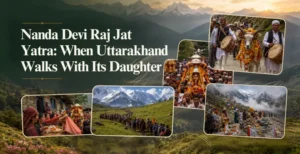
Village paths fill with people. Drums and damau echo through the valleys. Sacred dolis arrive from distant settlements. Women sing songs filled with affection and separation. Families offer clothes, food and gifts, just as they would for a daughter leaving her maternal home.
And at the front of this extraordinary procession may walk a rare four-horned ram.
This is the Nanda Devi Raj Jat Yatra.
To someone seeing it for the first time, it may appear to be a difficult Himalayan pilgrimage passing through villages, forests, alpine meadows and high mountain passes. For travellers planning a wider Uttarakhand travel experience, the region offers many destinations beyond the Raj Jat.
But the Raj Jat is much more than a trek.
It is the story of Maa Nanda returning from her maternal home to the home of Lord Shiva in the Himalayas.
For the people of Uttarakhand, Nanda is not only a goddess.
She is their daughter.
And the Raj Jat is her bidai.
What Is the Nanda Devi Raj Jat Yatra?
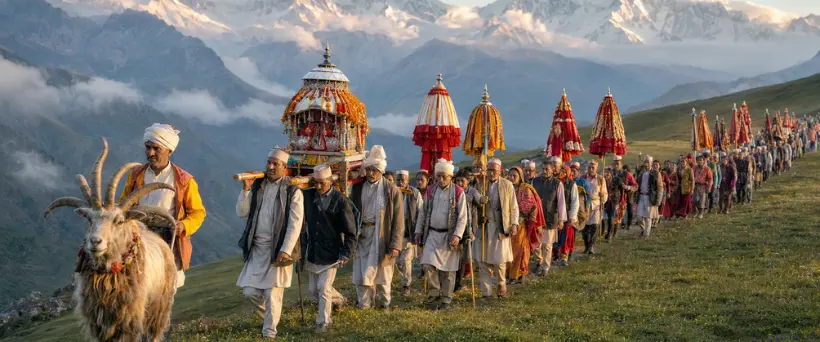
One of the major Himalayan pilgrimages in Uttarakhand is the Nanda Devi Raj Jat, popularly known as Nanda Raj Jat.
It is a great pilgrimage that, as per tradition, takes place once every 12 years, starting from the Nauti area of Chamoli and passing through villages, forests, bugyals, and mountainous regions to Homkund.
The traditional journey is often described as covering roughly 250–280 kilometres over several days.
But distance alone cannot explain its importance.
Every stage of the pilgrimage represents Maa Nanda moving farther away from her mait — her maternal home — and closer to the high mountains associated with Shiva and Kailash.
That is why people do not simply walk behind a deity.
They accompany a daughter on her journey home.
Who Is Maa Nanda?
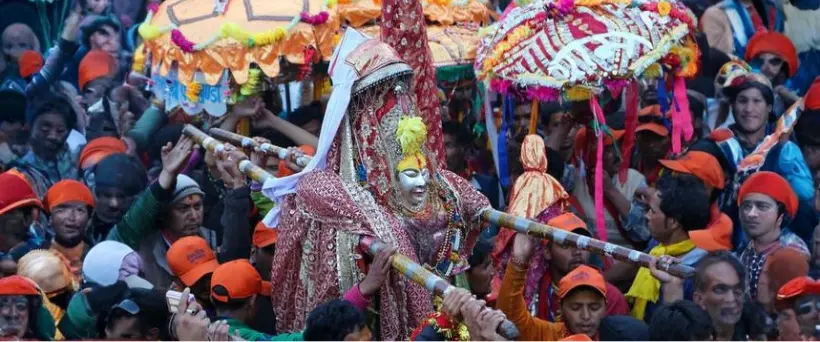
Across Garhwal and Kumaon, Maa Nanda is worshipped in different forms and traditions. She is closely associated with Parvati, Gaura and the consort of Lord Shiva.
However, in the folk imagination of the mountains, she is also deeply personal.
She belongs to the people.
She is welcomed like a daughter returning to her parents’ home. She is loved, celebrated and eventually prepared for her return to her husband’s home.
This simple human relationship gives the pilgrimage its emotional power.
During the Raj Jat, villagers do not only perform formal rituals. They sing traditional songs for Nanda, offer gifts and gather to see her procession pass.
The further she travels into the mountains, the harder the farewell becomes.
Perhaps that is why the Raj Jat feels different from many other pilgrimages.
It is based not only on worship.
It is based on love, attachment and separation.
How Old Is the Nanda Raj Jat?
The exact beginning of the Raj Jat is difficult to establish.
Different traditions connect Nanda worship with ancient and medieval Himalayan kingdoms, while other accounts associate the formal Raj Jat with the rulers of Garhwal.
Instead of having one clearly documented starting date, the pilgrimage appears to have developed over centuries through a combination of royal traditions, village customs, local deities and Himalayan faith.
Major Raj Jats are recorded in different periods, including journeys during the 20th and early 21st centuries.
The last grand Nanda Devi Raj Jat was held in 2014, after the pilgrimage originally planned for 2013 was postponed following the Uttarakhand disaster.
The next traditional Nauti-associated Raj Jat is currently planned for 2027.
A separate Nanda Devi Badi Jat from Kurud to Homkund is scheduled to begin on 5 September 2026, so travellers should not confuse the two programmes.
The Four-Horned Ram: Chausinghya Khadu
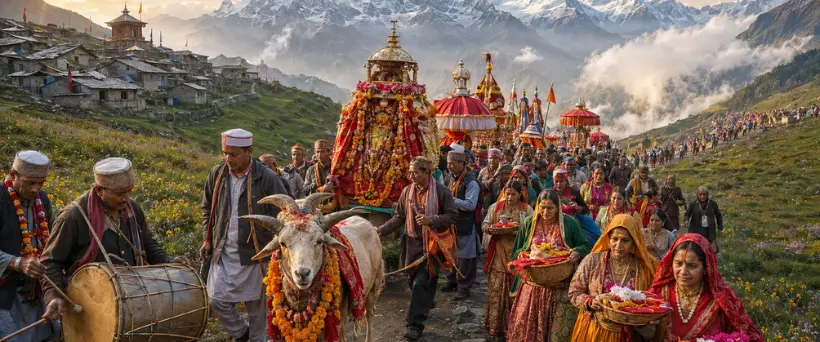
One of the most mysterious traditions associated with the Raj Jat is the Chausinghya Khadu, a rare ram born with four horns.
This animal is deemed sacred and occupies a special status in the pilgrimage of Maa Nanda.
Traditionally, the offerings made to the goddess are carried during the processional journey, and the Chausinghya Khadu leads the pilgrims into the Himalayas.
Then comes one of the most emotional moments of the entire yatra.
At Homkund, after the final rituals, the ram is released towards the mountains.
People do not continue walking behind it.
According to local belief, the ram carries Maa Nanda’s offerings onwards towards Kailash.
The pilgrims must turn back.
There is something deeply powerful about that moment.
After walking with Nanda for days, people finally have to let her go.
Chhantolis: When Villages Join the Journey
The Raj Jat is also known for its colourful sacred chhantolis, traditionally crafted using ringal, a Himalayan bamboo.
Different villages and communities bring their own religious symbols, dolis and chhantolis.
As the pilgrimage moves forward, more people join it.
The procession grows larger.
A journey that begins in one part of Chamoli slowly becomes a gathering of communities from across the mountain region.
This is what makes the Raj Jat feel less like an organised event and more like a moving expression of Rishikesh collective faith. The Raj Jat is also known for its colourful sacred chhantolis, traditionally crafted using ringal, a Himalayan bamboo.
Different villages and communities bring their own religious symbols, dolis and chhantolis.
As the pilgrimage moves forward, more people join it.
The procession grows larger.
A journey that begins in one part of Chamoli slowly becomes a gathering of communities from across the mountain region.
This is what makes the Raj Jat feel less like an organised event and more like a moving expression of Rishikesh collective faith.
From Nauti to Homkund: A Landscape That Tells the Story
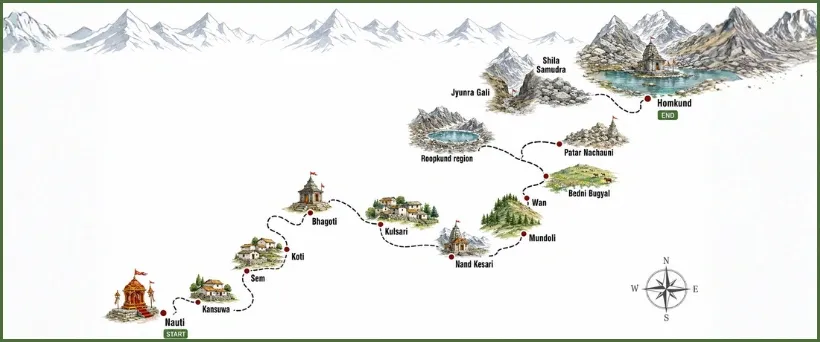
The traditional route is associated with places including:
Nauti → Kansuwa → Sem → Koti → Bhagoti → Kulsari → Nand Kesari → Mundoli → Wan → Bedni Bugyal → Patar Nachauni → Roopkund region → Jyunra Gali → Shila Samudra → Homkund
The exact halts can depend on the official programme.
What makes the route remarkable is how dramatically the landscape changes.
In the beginning, Nanda passes through villages filled with homes, people, temples and celebrations.
Then come the forests.
After that, the vast alpine meadows.
Finally, the inhabited world disappears almost completely and the procession enters a landscape of rock, wind, snow and high Himalayan silence.
Spiritually, the change feels meaningful.
The farther Nanda travels from home, the farther pilgrims move from the familiar human world.
Wan, Latu Devta and the Road Ahead
The village of Wan is an important point on the traditional route and is associated with Latu Devta, who is regarded in local tradition as closely connected with Maa Nanda and her journey.
Wan feels like a threshold.
Beyond it, the comfortable world of villages begins to fade.
The trail rises towards the high meadows, and the pilgrimage becomes physically harder.
From this point, faith is no longer expressed only through prayers.
It is expressed through every difficult step.
Bedni Bugyal: When the Mountain Becomes the Temple
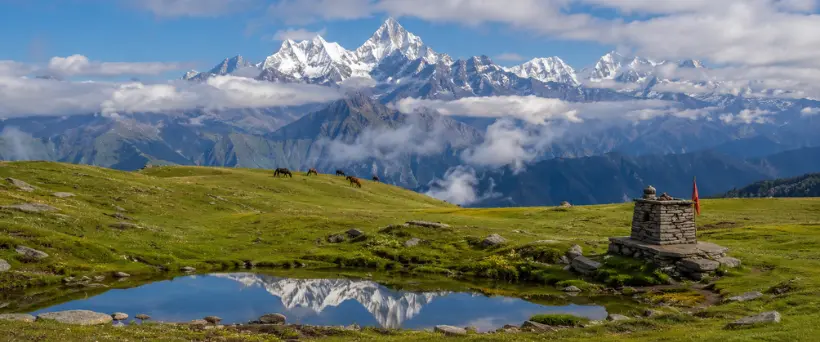
Then comes Bedni Bugyal, one of the most beautiful alpine meadows in the region.
But during the Raj Jat, it becomes far more than a scenic location.
Surrounded by open skies and mountains, pilgrims gather for rituals before continuing towards the higher sections.
There are no grand temple walls here.
The meadow itself becomes sacred space.
The wind, the grass, the distant peaks and the gathering of thousands of devotees become part of the experience.
The Raj Jat reminds you that in the Himalayas, a temple does not always need a roof.
Sometimes, the mountain itself is the temple.
Roopkund: Between Faith, Folklore and Mystery
The pilgrimage also passes through the region associated with Roopkund, the famous high-altitude lake known for human skeletal remains.
Local folklore connects the place with a royal procession that is believed to have offended the goddess and suffered a terrible fate in the mountains.
Modern scientific studies suggest a more complicated history, indicating that the remains belonged to different groups from different periods.
The two stories do not necessarily cancel each other out.
Science asks who the people were and when they died.
Folklore tells us how generations of Himalayan communities understood the danger and sacredness of the mountains.
Roopkund therefore remains a place where history, mystery and belief meet.
Homkund: Where the Farewell Becomes Real
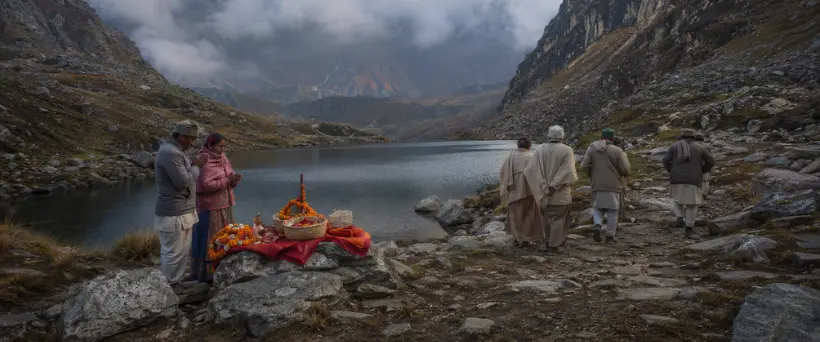
Eventually, the procession reaches Homkund.
By now, the villages are far behind.
So are the celebrations of the lower valleys.
Here, surrounded by the silence of the high Himalayas, the final rituals are performed.
Offerings are made.
Maa Nanda has reached the end of the journey that her devotees can physically accompany.
The Chausinghya Khadu is released.
And the people turn back.
This is the heart of the Raj Jat.
It is not simply about reaching Homkund.
It is about understanding that there comes a point when love means letting someone continue without you.
People may worship Maa Nanda as a goddess.
But at Homkund, they say goodbye to her like a daughter.
Is the Nanda Raj Jat a Trek?
The Raj Jat involves demanding trekking, but it should be understood as a pilgrimage first.
Participants may encounter steep trails, rain, cold temperatures, high altitude, long walking days and limited facilities.
Anyone planning to join should prepare physically, follow official medical and safety instructions and respect local customs.
Visitors should also avoid treating sacred ceremonies as tourist performances.
Listen to the songs.
Observe the rituals.
Ask before photographing people closely.
Carry your waste back.
And remember that the person walking beside you may not see the journey as an adventure at all.
For them, Maa Nanda is going home.
Planning Your Nanda Devi Raj Jat Journey
Before embarking on the Nanda Devi Raj Jat, it would help to know the latest guidelines regarding dates, registration process, route conditions, medical fitness, weather, and accessibility of the high-altitude routes.For broader Uttarakhand travel planning, Dazonn Travels can also assist with itinerary and travel arrangements based on your requirements.
It is certainly not a trekking expedition that could be undertaken just based on distance or difficulty levels. The trek route is through the rugged Himalayan region, and guidelines may vary from one pilgrimage season to another.
Preparation of your body is important, but so is preparation of your mind.
Learn about the places that you will be trekking through. Learn the stories of Maa Nanda and respect the traditions and the people who have kept this living tradition alive for generations.
Because a journey like this should not begin simply by asking:
- How many kilometres will I walk?
It should begin by asking:
- Whose journey am I becoming part of?
More Than a Pilgrimage
Eventually, everyone who walks towards Homkund has to return.
The mountains remain.
The songs return to the villages.
The procession slowly disappears.
But the emotion of the farewell stays behind.
That is perhaps the simplest way to understand the Nanda Devi Raj Jat Yatra.
It is not only a pilgrimage through some of Uttarakhand’s most spectacular landscapes.
It is Uttarakhand walking with its daughter as far as it can — and then trusting the mountains to take her home.
FAQs About Nanda Devi Raj Jat
The pilgrimage symbolically represents Maa Nanda leaving her maternal home in Uttarakhand and travelling towards her marital home associated with Shiva and Kailash.
The grand pilgrimage is traditionally associated with a cycle of approximately 12 years, although actual dates may change.
The traditional pilgrimage is associated with Nauti in Chamoli district, Uttarakhand.
Its sacred outward journey culminates at Homkund in the high Himalayas.
It is a rare four-horned ram with an important ceremonial role in the pilgrimage. Traditionally, it is released towards the mountains near the conclusion of the journey.
The traditional Nauti-associated grand Raj Jat is currently planned for 2027.